
Exploring how AI can help recruiters express search intent while preserving transparency, control, and trust.
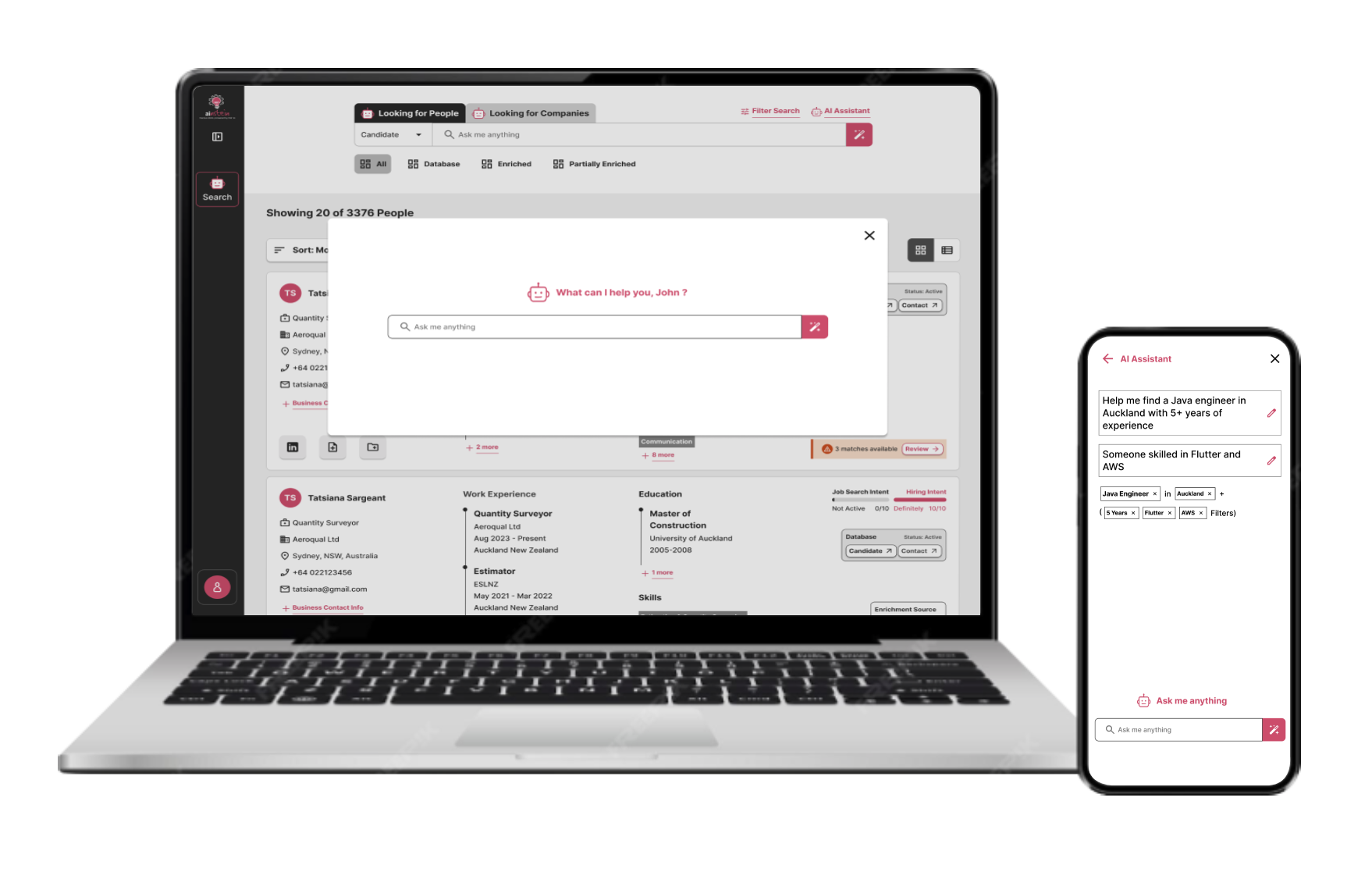
This case study focuses on designing a hybrid AI-assisted search experience for an AI-powered recruitment platform, where recruiters need to translate complex hiring intent into accurate and explainable search results. The challenge was supporting natural language and AI-driven discovery without introducing non-transparent 'black box' behaviour or removing users’ control over search criteria.
The solution explored a progressive search model that allows recruiters to move fluidly between structured filters, natural language input, and AI-assisted refinement. By making AI-derived criteria visible, editable, and reversible, the experience balanced flexibility with transparency, helping recruiters search more effectively while maintaining trust in how results were generated.
ai.nstein is an AI-powered recruitment platform that aggregates and enriches candidate data from multiple sources to support talent search and evaluation. As a Product Designer (UX/UI), I focused on designing the search experience, exploring how AI could assist recruiters in expressing intent while fitting naturally into existing search behaviours and workflows.
This work centred on balancing innovation with reliability by introducing AI assistance in a way that complements traditional filter-based search, supports different levels of user expertise, and preserves clarity around why specific candidates appear in results.
Recruiters often search for candidates using a combination of keywords, filters, and domain knowledge built through experience. However, as hiring criteria become more nuanced and combine skills, experience, location, seniority, and context, traditional keyword or filter-only search can feel rigid and time-consuming.
While natural language and AI-powered search offer the promise of faster and more intuitive discovery, fully automated or conversational approaches can feel non-transparent and risky in high-stakes hiring decisions. Recruiters need confidence not only in the results themselves, but also in how those results were produced, particularly when AI is involved.
• Recruiters expressed search intent in different ways, ranging from structured filters to vague or conversational descriptions.
• Pure AI or chat-based search risked feeling non-transparent, making it difficult to understand or trust results.
• Translating natural language intent into structured, actionable criteria required clarity and user oversight.
• Users needed to refine and iterate on search results without losing context or control.
• The search experience had to support both novice users and power users within the same system.
• Support multiple search entry points, including filters and natural language input.
• Use AI to assist in interpreting intent without replacing user decision-making.
• Make AI-derived search criteria visible, editable, and reversible.
• Allow recruiters to iteratively refine searches while maintaining transparency.
• Integrate AI assistance into existing recruiter workflows without disruption.
1. Increased confidence in AI-assisted search
Recruiters reported greater confidence during early validation sessions when using AI to support search, as derived criteria were visible and editable, reducing hesitation around AI-driven discovery.
2. Improved transparency in how results were generated
Making system-interpreted intent explicit helped users understand why candidates appeared in results, improving trust and reducing perceptions of non-transparent or “black box” behaviour.
3. Reduced risk of over-automation
By positioning AI as an assistive layer rather than a replacement for filters, users retained control over search decisions and could refine results without losing context.
4. Better support for different user expertise levels
The hybrid search model accommodated both filter-driven power users and recruiters who preferred natural language input, without fragmenting the overall experience.
5. Clear direction for future iteration
Early validation sessions confirmed the value of progressive AI assistance and highlighted opportunities to further improve explainability, confidence signalling, and refinement as adoption increases.
While this work is still evolving, the following metrics were identified to evaluate the effectiveness of the AI-assisted search experience post-launch:
• Adoption rate of natural language and AI-assisted search entry points.
• Percentage of AI-derived criteria that were reviewed or edited by users.
• Search refinement rate versus full search restarts.
• Drop-off or abandonment rate during search refinement.
• Qualitative confidence signals collected during user feedback and testing sessions.
These metrics help assess whether AI assistance is improving search efficiency and confidence without compromising transparency or user control.
Product Designer (UX/UI) (Solo Designer)
Owned the end-to-end design of the AI-assisted search experience, from problem framing and user research through interaction design and early validation.Focused on helping recruiters express complex search intent while preserving transparency, explainability, and user control in AI-driven discovery.
1 x Project Manager
1 x Business Analyst
4 x Developers
Collaborated closely with product and engineering to align UX decisions with technical constraints, search performance considerations, and AI interpretability requirements.
Ongoing (active development)
Jira, Miro, Google Sheets, Loveable, Figma, Maze
Web platform with seamless mobile responsiveness.
• Trust-first AI-assisted search that preserves recruiter control
• Explainable and editable AI-derived search criteria
• Validated through early usability testing and client feedback
“ I like that I can see what the AI is doing and change it instead of starting over.”
Usability testing feedback
Designing an AI-assisted search experience required careful trade-offs between speed, flexibility, and user trust. Recruiters rely on search to make high-impact decisions under time pressure, which meant AI support had to enhance clarity and control rather than replace familiar workflows or introduce opaque behaviour.
The following UX decisions were shaped by real client feedback and early validation sessions. Each decision focused on making AI assistance explainable, editable, and reversible, ensuring recruiters could adopt new search capabilities confidently while retaining ownership over how results were generated.
.png)
Together, these decisions grounded AI-assisted search in transparency and user control. By keeping intent visible, workflows familiar, and automation reversible, the experience enabled recruiters to adopt AI confidently without sacrificing speed, accuracy, or trust in how results were produced.
The UI implementation translated trust-first UX decisions into a clear, flexible search experience that balanced speed, transparency, and user control. Rather than treating AI search as a separate or opaque interaction, the interface embedded AI assistance into familiar search patterns, allowing recruiters to express intent naturally while maintaining visibility into how results were generated.
Across the experience, AI-derived behaviour was surfaced as structured, editable UI elements. Search criteria remained visible, adjustable, and reversible, enabling recruiters to reason about AI interpretation before and after running a search, rather than reacting to unexplained outcomes.
• Search intent should be visible and editable, not hidden behind AI outputs
• AI assistance should complement existing workflows rather than replace them
• Refinement should be iterative and continuous without resetting context
By aligning interface behaviour with recruiter mental models and real-world hiring workflows, the solution reduced friction, avoided “black box” search behaviour, and supported confident decision-making in time-sensitive recruitment scenarios.
.png)
.png)
.png)
As this work continues to evolve, early validation sessions played a key role in shaping and refining the experience. We conducted one-on-one sessions with a small group of recruiters to evaluate the AI-assisted search flow and test our initial hypotheses.
Participants reported increased confidence when using AI to refine search intent, particularly when AI-suggested criteria were transparent and easy to adjust. Making the system’s interpretation visible reduced hesitation around AI-driven discovery and helped recruiters feel more in control of the search process.
These insights reinforced the trust-first design direction and informed next steps for continued iteration and improvement.

This phase validated the core design principles while highlighting opportunities for further refinement through continued product monitoring and iteration.